Say you’ve taken my advice from last week, and you’ve recorded yourself explaining your work. Maybe you feel like your little two-minute summary is still all over the place, full of “oh yeah, but also” and “oh and another thing” and “something I forgot to say.”
How do you get from a two-minute rough draft to a polished summary for why your work is important?
It’s all about focus.

This summary may look like the “significance” section in an NIH grant. It might also look like an abstract for a presentation, a script for that presentation, a white paper to give a donor, a summary for media or communications.
I like to break up that two-minute summary and use it as an outline to expand into. Maybe each statement is now a header for a paragraph that will include supporting data.
But, before you start writing each paragraph, make sure you have a header that walks a reviewer clearly through the “so what.” Chances are you’ve done this naturally, but it’s impactful to organize these headers from big to small. Most general to most specific.
Lead reviewer through arc of knowledge: what we knew… then we knew more… then we knew more… and my proposal is the logical next step to know even more.
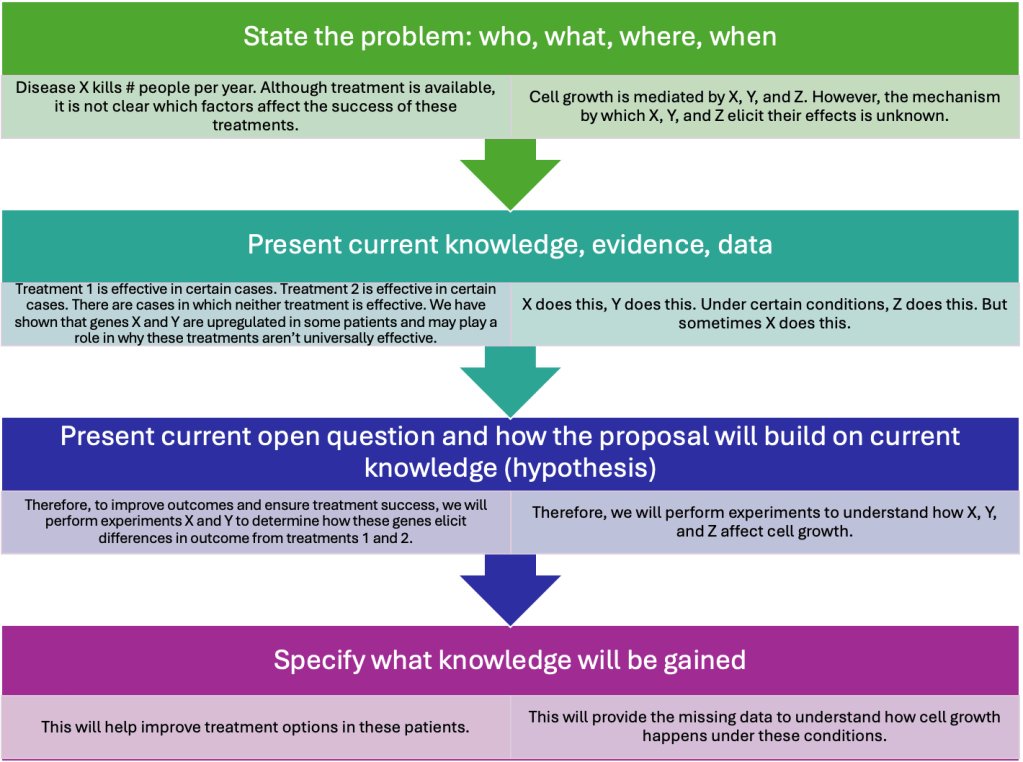
You don’t talk about the genes before you’ve talked about the burden of the disease. You don’t talk about the burden and then the genes but wait oh yeah current treatments aren’t good. General to specific, each header getting more and more focused on the specific problem your work will solve.
The more focused you are, the more likely a reviewer is going to follow your logic.
You don’t want the reviewer to have any doubt that what you’re proposing is the logical next step to advance the field.
This also isn’t a time to muddy the waters with irrelevant information. Don’t overshare data, don’t overshare facts. You don’t need to talk about treatments 3 and 4, or prevention, or every single clinical trial that’s ever been done in this disease.
Focus!

Leave a Reply